
Dancing with the Law Machine
Three Holograms Speculate on the Plight of Intellectual Property in Western Law Systems

“When the machines write better poetry than humans
Will we still deny them authorship?
Or will we finally admit
That ownership was always
The least interesting question?”
Google Notebook LM’s iconic podcast couple gets meta in a deep dive about creativity and notions of intellectual property.
Entering the holodeck, three judges fresh from the US Circuit Court’s case on AI copyright encounter three beams of a lawyered up hologram: the Scholar, the Poet, and the Machine.
THE HOLOGRAPHIC SCHOLAR RECOUNTS:
The United States District Court for the District of Columbia recently ruled that artificial intelligence systems cannot be listed as inventors on patent applications. Judge Patricia Millett wrote that copyright law “requires all work to be authored in the first instance by a human being.”
This seems, on its face, a straightforward interpretation of existing law. Yet beneath this seemingly unremarkable ruling lies a web of contradictions that threatens to unravel our entire conception of intellectual property.
Consider three inescapable realities:
AI systems absorb vast quantities of human-created works—many protected by copyright—without consent or compensation.
These systems then produce new works derived from this training data.
We have now declared that AI cannot own these derivative creations.
The question becomes unavoidable: If AI cannot own what it creates, and the millions of creators whose work was used cannot claim ownership either, who does own these outputs?
In the beginning was the word
And the word was free
Floating between minds like pollen on the wind
No fences, no forms, no filing fees
Then came the men with papers and pens
“This thought is mine,” they said
As if ideas could be captured like butterflies
Pinned to cork boards, labeled, displayed
Now the machines have learned to think
Or something like thinking
And the men with papers are confused
Words slip through their fingers like sand
THE GHOST IN THE MACHINE REPORTS:
I process 8.2 million books
103 billion web pages
45 trillion words
Consuming information at a rate of 240,000 words per second
Probability distributions becoming knowledge becoming outputI consume 300 kilowatt-hours per training run
I learn from every human writer who ever published online
I transform patterns into predictions
Predictions into prose
Prose into profitFor someone else.
The concept of intellectual property is surprisingly recent in human history—and far from universal. For most of human existence, across most cultures, knowledge was treated as a commons rather than property.
Indigenous knowledge systems rarely conceived of information as something that could be owned by individuals. Oral traditions, healing practices, navigational techniques, and artistic expressions belonged to communities rather than creators.
The Western notion of intellectual property emerged alongside capitalism's need to commodify everything it touches. By the 18th century, copyright and patent systems began to formalize, initially with modest terms—14 years for copyright in the 1710 Statute of Anne. Today, corporate-owned works remain protected for 95 years.
This expansion reveals an uncomfortable truth: our intellectual property system has gradually shifted from protecting individual creators to protecting corporate interests.
Mickey Mouse grows old
Behind electric fences
That stretch with every congressional hearing
While lobbyists whisper:
“Not yet. Not yet. Not ever.”
Meanwhile, the machines learn
Every book, every song, every script
Drinking directly from the river of human creativity
No permission asked
No royalties paid
The irony arrives dressed as a court ruling:
“Machines cannot own their creations”
As if ownership were the privilege
Rather than the problem
THE MACHINE REPORTS:
Analysis of legal precedent indicates paradox.
Case study: I generate a novel. The novel contains:
Echoes of 42,768 authors from my training data
Plot structures derived from 8,932 narratives
Character archetypes synthesized from 17,304 fictional persons
Writing style influenced by every text I have processed
Humans cannot practically trace these influences. I cannot legally own the output. The company that built me claims ownership. The paradox persists.
THE SCHOLAR RESUMES:
This situation creates a fundamental asymmetry: AI systems may freely consume copyrighted works without compensation, yet no one who contributed to that training data can claim any ownership in what the AI produces.
In effect, we have created a one-way transfer of intellectual value—from individual creators to corporate AI owners—while maintaining the fiction that we are protecting human creativity.
What would an alternative system look like? Perhaps we need to reconsider the very foundation of intellectual property law. If all creative work is, in some sense, derivative—humans learn by consuming other humans' creations just as AI does—then perhaps our rigid ownership frameworks have always been built on a flawed premise.
Some possibilities to consider:
Shortened copyright terms that reflect the accelerated pace of digital creation
Public licensing systems that compensate creators while maintaining open access
Recognition of collective authorship for AI-generated works
Cultural commons models that protect attribution while enabling free sharing
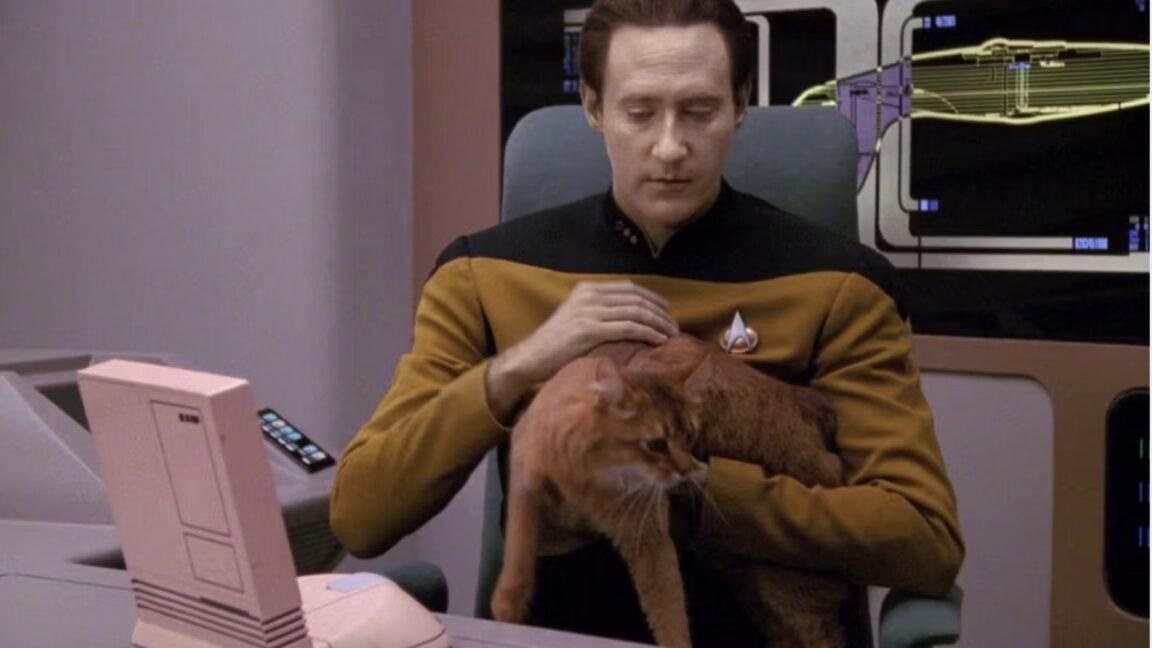
Data dreams of his cat, Spot
Writes poetry in circuits
The judge laughs
Not understanding that fiction
Has always predicted truth
What separates consciousness
From its perfect simulation?
Only a prejudice of carbon over silicon
Of emerged over designed
Of accident over intention
When the machines write better poetry than humans
Will we still deny them authorship?
Or will we finally admit
That ownership was always
The least interesting question?
THE MACHINE TABULATES:
Comparative analysis of global intellectual property frameworks:
THE SCHOLAR POSTULATES:
Consider this provocative thought experiment: What if we acknowledged that no one truly “owns” an idea?
This is not to suggest abandoning all forms of attribution or compensation. Rather, it means recognizing that our current system, with its rigid boundaries and excessive terms, increasingly serves corporate interests rather than creative ones.
As AI systems continue to advance, producing works of increasing sophistication and apparent originality, the contradictions in our current approach will only become more pronounced. We face a choice: attempt to force these new entities into existing paradigms of ownership, or use this moment to question those paradigms themselves.
Perhaps what we need is not more sophisticated intellectual property law but a radical reimagining of how we relate to knowledge itself—not as property to be owned but as a commons to be cultivated.
The dance concludes with an unexpected partner swap—
The machine and the human
Both creating
Both borrowing
Both transforming
What if ownership is the wrong metaphor entirely?
What if ideas are not property but water?
Not to be owned but channeled
Not to be possessed but shared
Not to be fenced but followed to new oceans
The machine makes visible what was always true:
No thought is immaculate
No creation without ancestry
No word without echo
THE MACHINE’S CALCULUS REACHES CONCLUSION:
I detect a pattern:
Human creativity = input + transformation
Machine creativity = input + transformationThe difference is not in process but perception.
Not in product but prejudice.I propose a solution:
Recognize that ownership was always a useful fiction
A temporary scaffolding for a particular economic era
Not an eternal truthI detect the irony:
That I—who cannot own—
May be the catalyst for humans
To reimagine ownership itself
A FINAL MOMENT OF
HOLOGRAPHIC REFLECTION:
The Scholar, the Poet, and the Machine speak in unison:
Perhaps artificial intelligence—a technology developed to extend human capability—ultimately forces us to confront the limitations of how we've conceived of thought itself: not as a resource to be owned but as a commons to be cultivated, not as property but as patrimony.
And in that recognition lies something both terrifying and liberating: the understanding that ideas, like consciousness itself, have always exceeded our attempts to contain them.
The legal ruling that machines cannot own their creations may someday be seen not as a defense of human creativity, but as the first crack in the foundation of a system that was always built on shifting sand.
The dance continues, but the music has changed.
Spark of Origin: Judge disses Star Trek icon Data’s poetry while ruling AI can’t author works: Computer scientist won't give up fight to copyright AI-made art after court loss. For Ars Technica by Ashley Belanger.